


CNN cited the American Immigration Council's recent report ...
New Americans in Arkansas |
 The Political and Economic Power of Immigrants, Latinos, and Asians in the Natural State
Download the Fact Sheet (Updated 2015)
View the Innovation and Entrepreneurship Fact Sheet for Arkansas
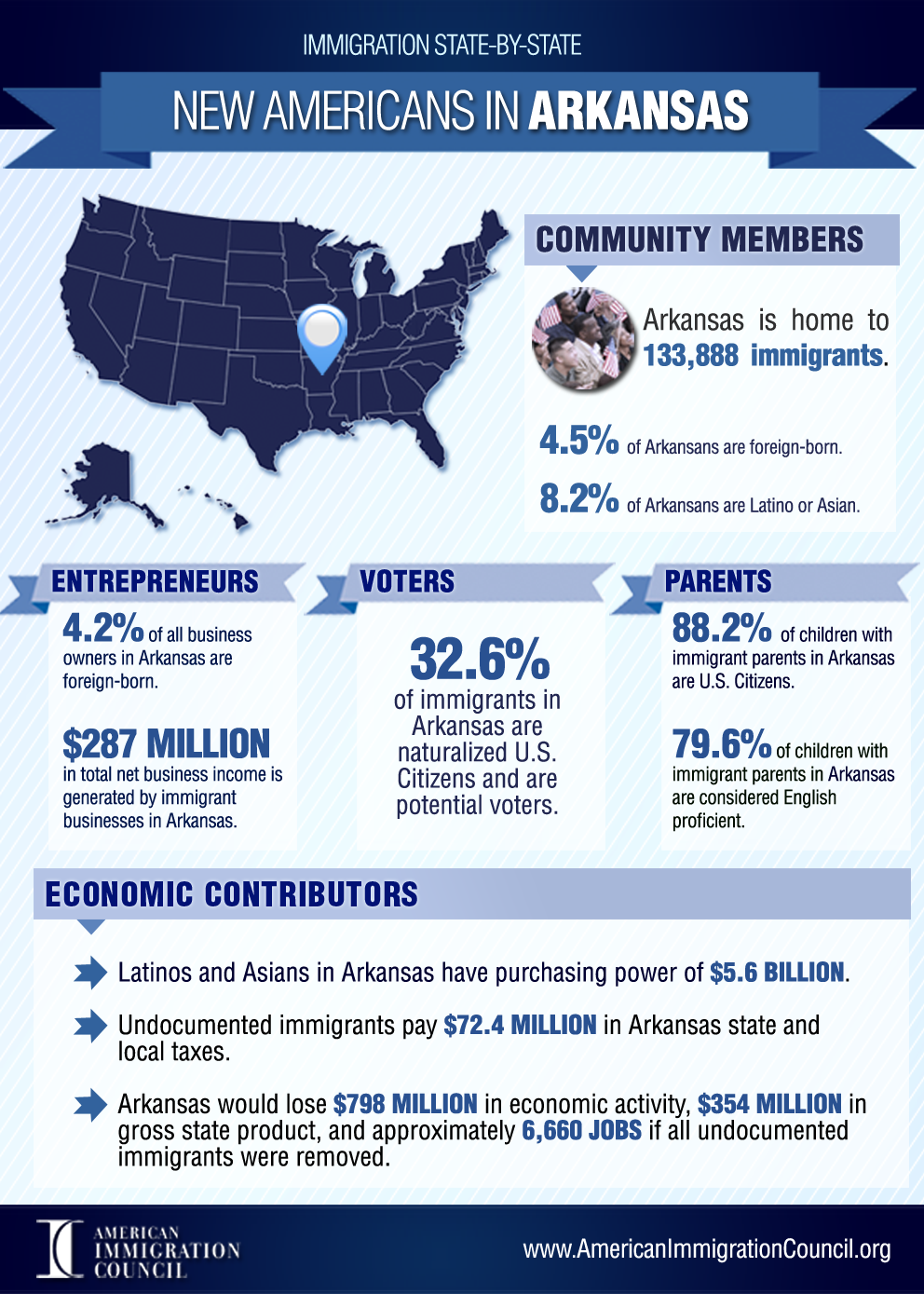
Immigrants, Latinos, and Asians account for large and growing shares of the economy and population in Arkansas. Immigrants (the foreign-born) make up 4.5% of the state’s population, and more than one-quarter of them are naturalized U.S. citizens who are eligible to vote. Immigrants account for 6.5% of Arkansas workers. Moreover, Latinos and Asians (both foreign-born and native-born) wield roughly $5.6 billion in consumer purchasing power, and the businesses they own had sales and receipts of $1.7 billion and employed more than 11,000 people at last count. At a time when the economy is still recovering, Arkansas can ill-afford to alienate such an important component of its labor force, tax base, and business community.
Immigrants and their children are growing shares of Arkansas’s population.
- The foreign-born share of Arkansas’s population rose from 1.1% in 1990, to 2.8% in 2000, to 4.5% in 2013, according to the U.S. Census Bureau. Arkansas was home to 133,888 immigrants in 2013, which is greater than the population of Springfield, Illinois.
- 32.6% of immigrants (or 43,677 people) in Arkansas were naturalized U.S. citizens in 2013—meaning that they are eligible to vote.
- Unauthorized immigrants comprised 2% of the state’s population (or 60,000 people) in 2012, according to a report by the Pew Hispanic Center.
- 2% (or 27,906) of all registered voters in Arkansas were “New Americans”—naturalized citizens or the U.S.-born children of immigrants who were raised during the current era of immigration from Latin America and Asia which began in 1965—according to an analysis of 2012 Census Bureau data by the American Immigration Council.
More than 8% of Arkansans are Latino or Asian.
- The Latino share of Arkansas’s population grew from 0.8% in 1990, to 3.2% in 2000, to 6.9% (or 203,111 people) in 2013. The Asian share of the population grew from 0.5% in 1990, to 0.8% in 2000, to 1.3% (or 39,210 people) in 2013, according to the U.S. Census Bureau.
- In Arkansas, 88.2% of children with immigrant parents were U.S. citizens in 2009, according to data from the Urban Institute.
- In 2009, 91.5% of children in Asian families in Arkansas were U.S. citizens, as were 89.5% of children in Latino families.
Immigrant, Latino, and Asian entrepreneurs and consumers add billions of dollars and thousands of jobs to Arkansas’s economy.
- The 2014 purchasing power of Arkansas’s Latinos totaled $3.9 billion—an increase of 2,515% since 1990. Asian buying power totaled $1.7 billion—an increase of 1,080% since 1990, according to the Selig Center for Economic Growth at the University of Georgia.
- Immigration boosts housing values in communities. For example, from 2000 to 2010, according to the Americas Society/Council of the Americas, the value added by immigration to the price of the average home was $1,054 in Pulaski County.
- Arkansas’s 5,436 Latino-owned businesses had sales and receipts of $821 million and employed 4,269 people in 2007, the last year for which data is available. The state’s 3,322 Asian-owned businesses had sales and receipts of $855.7 million and employed 7,285 people in 2007, according to the U.S. Census Bureau’s Survey of Business Owners.
- From 2006 to 2010, there were 6,171 new immigrant business owners in Arkansas, and new immigrant business owners had total net business income of $287 million (which is 4.7% of all net business income in the state), according to Robert Fairlie of the University of California, Santa Cruz.
- In 2010, 4.2% of all business owners in Arkansas were foreign-born, according to the Fiscal Policy Institute.
Immigrants are integral to Arkansas’s economy as workers and taxpayers.
- Immigrants comprised 6.5% of the state’s workforce in 2013 (or 88,200 workers), according to the U.S. Census Bureau.
- Unauthorized immigrants comprised 3.2% of the state’s workforce (or 45,000 workers) in 2012, according to a report by the Pew Hispanic Center.
- Latinos in Arkansas paid $294 million in federal taxes and $192 million in state/local taxes in 2013, according to the Partnership for a New American Economy. In particular, foreign-born Latinos paid $176 million in federal taxes and $125 million in state/local taxes.
- The federal tax contribution of Arkansas’s Latino population included over $231 million to Social Security and $54 million to Medicare in 2013. Foreign-born Latinos contributed over $148 million to Social Security and $35 million to Medicare that year.
Unauthorized immigrants pay taxes.
- Unauthorized immigrants in Arkansas paid $72.4 million in state and local taxes in 2010, including $58.5 million in sales taxes, $9.4 million in state income taxes, and $4.5 million in property taxes, according to data from the Institute for Taxation and Economic Policy.
- Were unauthorized immigrants in Arkansas to have legal status, they would pay $88.9 million in state and local taxes, including $61.7 million in sales taxes, $22.3 million in state income taxes, and $4.9 million in property taxes.
- If all unauthorized immigrants were removed from Arkansas, the state would lose $798 million in economic activity, $354 million in gross state product, and approximately 6,660 jobs, even accounting for adequate market adjustment time, according to a report by the Perryman Group.
Immigrants contribute to Arkansas’s economy as students.
- Arkansas’s 4,964 foreign students contributed over $129 million to the state’s economy in tuition, fees, and living expenses for the 2013-2014 academic year, according to NAFSA: Association of International Educators.
- Foreign students contribute to Arkansas’ metropolitan areas. From 2008 to 2012, according to the Brookings Institution, 2,063 foreign students paid $25.9 million in tuition and $13.3 million in living costs in the Little Rock-North Little Rock-Conway metropolitan area. In the Jonesboro metro area, 2,705 foreign students paid $31 million in tuition and $16.2 million in living costs. In the Fayetteville-Springdale-Rogers metro area, 2,382 foreign students paid $38 million in tuition and $24 million in living costs.
- Foreign students also contribute to innovation in Arkansas. In 2009, “non-resident aliens” comprised 40.8% of masters degrees and 53.2% of doctorate degrees in science, technology, engineering, and mathematics (STEM) fields, according to the Partnership for a New American Economy.
Naturalized citizens excel educationally.
- In Arkansas, 23.7% of foreign-born persons who were naturalized U.S. citizens in 2011 had a bachelor’s or higher degree, compared to 16.4% of noncitizens. At the same time, only 30.9% of naturalized citizens lacked a high-school diploma, compared to 50.5% of noncitizens.
- The number of immigrants in Arkansas with a college degree increased by 88.2% between 2000 and 2011, according to data from the Migration Policy Institute.
- In Arkansas, 79.6% of children with immigrant parents were considered “English proficient” as of 2009.
- The English proficiency rate among Asian children in Arkansas was 87.4%, while for Latino children it was 80.5%, as of 2009.
Published On: Thu, Jan 01, 2015 | Download File




Obama's Executive Action

Read Our Blog
Read the latest in immigration news at ImmigrationImpact.com, with new articles published every weekday.
Text FACTS to 51555 to get the latest posts sent right to your phone.

Immigration by State
 Find out how much Latinos, Asians and immigrants contribute to your state.
U.S. Immigration Guide
Read our guide to how the United States immigration system works, and our resource page on the problems with it, as well as the possible solutions.